Reveal means to make something known, visible, or understood that was previously hidden or secret. Imagine a magician pulling away a curtain to show an amazing surprise. That moment is a perfect example of reveal because something hidden becomes visible. The word is widely used in everyday conversations, news, storytelling, business, science, and social media. Learning synonyms for reveal helps you express different ways of showing, uncovering, or sharing information more accurately.
Expanding your vocabulary with synonyms for reveal helps English learners, students, teachers, and content writers avoid repeating the same word. It also makes writing and speaking more natural, engaging, and professional.
In this article, you will learn the meaning of reveal, its pronunciation, grammar, history, connotation, semantic categories, and 30 useful synonyms for reveal with simple meanings and easy examples.
Meaning of Reveal
Definition
Reveal (Verb):
To make something known, visible, or easy to understand that was previously hidden or secret.
Examples
- She revealed the surprise at the birthday party.
- The report revealed important facts about the project.
Connotative Meaning
(Connotation means the emotional feeling or idea that a word suggests beyond its dictionary meaning.)
- Positive Tone: Honest, informative, helpful, enlightening.
- Negative Tone: Can suggest exposing secrets or private information.
- Neutral Tone: Simply means making something known or visible.
Etymology
- Source Language: Old French
- Original Word: reveler
- Original Meaning: To uncover or make known.
- Latin Root: re- (back) + velum (veil or covering).
Short History
- Old English (450–1100): The exact word did not exist.
- Middle English (1100–1500): Reveal entered English through Old French.
- Modern English (1500–Present): The word became widely used to describe uncovering facts, secrets, discoveries, and emotions.
Pronunciation (US & UK – IPA)
- US: /rɪˈvil/
- UK: /rɪˈviːl/
Syllables
re-veal
Affixation Pattern of Reveal
- Root: veal (from Latin root meaning “cover”)
- Prefix: re-
- Suffix: None
Word Formation of Reveal
- Reveal (Verb)
- Reveal (Noun)
- Revealed (Adjective/Verb)
- Revealing (Adjective/Verb)
- Revelation (Noun)
- Revealer (Noun)
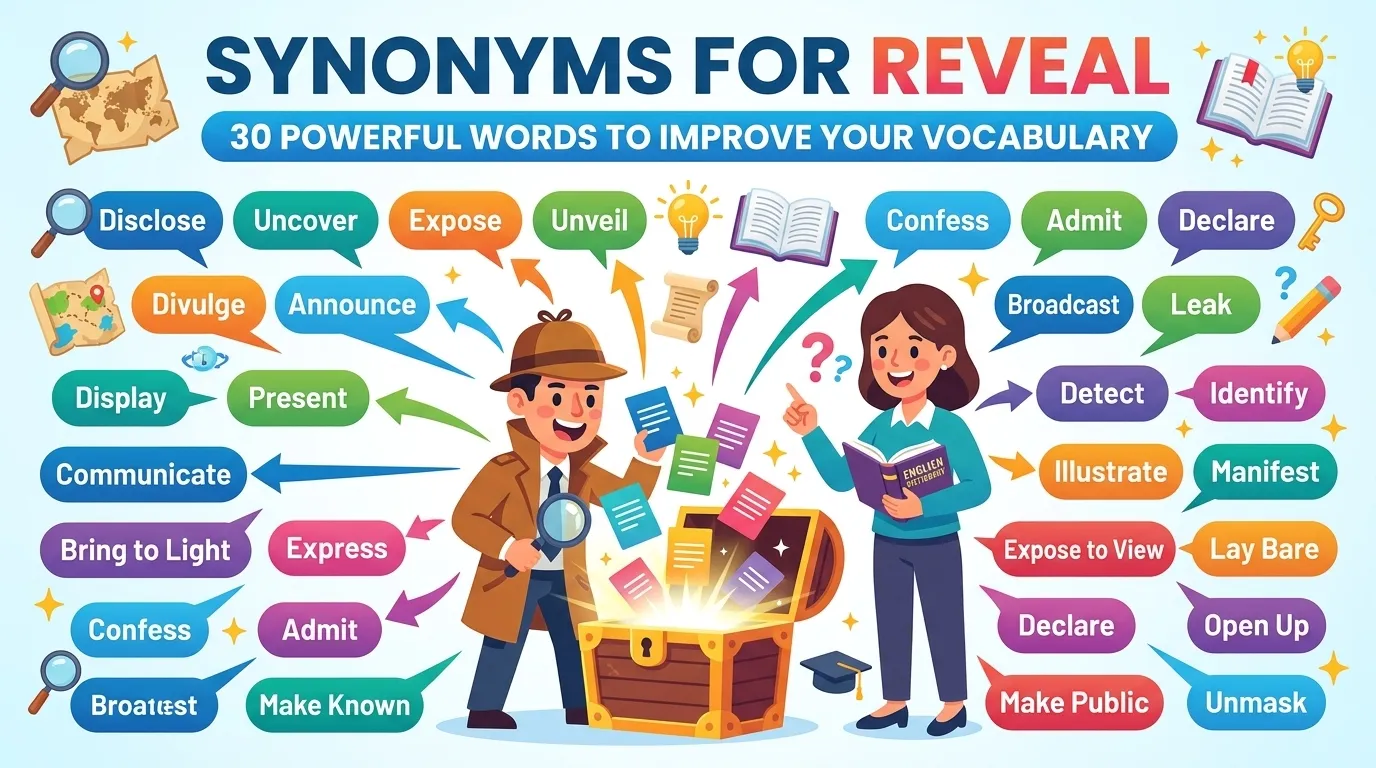
Synonyms of Reveal with Meanings and Examples
1. Disclose (Verb)
US: /dɪˈskloʊz/ | UK: /dɪˈskləʊz/
Meaning: To make secret information known.
Examples:
- The company disclosed its annual profits.
- She refused to disclose her password.
2. Uncover (Verb)
US: /ʌnˈkʌvər/ | UK: /ʌnˈkʌvə/
Meaning: To remove a covering or discover something hidden.
Examples:
- Police uncovered new evidence.
- The workers uncovered ancient ruins.
3. Expose (Verb)
US: /ɪkˈspoʊz/ | UK: /ɪkˈspəʊz/
Meaning: To make something visible or publicly known.
Examples:
- The newspaper exposed the corruption.
- Sunlight exposed the painting’s true colors.
4. Unveil (Verb)
US: /ʌnˈveɪl/ | UK: /ʌnˈveɪl/
Meaning: To officially show something for the first time.
Examples:
- The company unveiled a new product.
- They unveiled the statue yesterday.
5. Divulge (Verb)
US: /daɪˈvʌldʒ/ | UK: /daɪˈvʌldʒ/
Meaning: To tell private or secret information.
Examples:
- He refused to divulge the details.
- Never divulge personal information online.
6. Announce (Verb)
US: /əˈnaʊns/ | UK: /əˈnaʊns/
Meaning: To tell people something officially.
Examples:
- The school announced the results.
- They announced the winner.
7. Show (Verb)
US: /ʃoʊ/ | UK: /ʃəʊ/
Meaning: To let someone see something.
Examples:
- Please show me your project.
- She showed her new painting.
8. Display (Verb)
US: /dɪˈspleɪ/ | UK: /dɪˈspleɪ/
Meaning: To put something where people can easily see it.
Examples:
- The museum displayed ancient coins.
- The shop displayed new clothes.
9. Present (Verb)
US: /prɪˈzent/ | UK: /prɪˈzent/
Meaning: To give or show something formally.
Examples:
- She presented her research.
- The team presented a new plan.
10. Publish (Verb)
US: /ˈpʌblɪʃ/ | UK: /ˈpʌblɪʃ/
Meaning: To make written information available to the public.
Examples:
- The author published a new book.
- Scientists published their findings.
11. Demonstrate (Verb)
US: /ˈdɛmənˌstreɪt/ | UK: /ˈdemənstreɪt/
Meaning: To clearly show or explain something.
Examples:
- The teacher demonstrated the experiment.
- The results demonstrated the theory.
12. Communicate (Verb)
US: /kəˈmjunəˌkeɪt/ | UK: /kəˈmjuːnɪkeɪt/
Meaning: To share information with others.
Examples:
- Good leaders communicate clearly.
- She communicated her ideas confidently.
13. Express (Verb)
US: /ɪkˈsprɛs/ | UK: /ɪkˈspres/
Meaning: To show thoughts or feelings.
Examples:
- He expressed his opinion politely.
- She expressed her gratitude.
14. Bring to Light (Verb Phrase)
US: /brɪŋ tə laɪt/ | UK: /brɪŋ tə laɪt/
Meaning: To make hidden facts known.
Examples:
- The investigation brought the truth to light.
- New evidence brought the mistake to light.
15. Make Known (Verb Phrase)
US: /meɪk noʊn/ | UK: /meɪk nəʊn/
Meaning: To inform others about something.
Examples:
- The company made its decision known.
- She made her plans known to everyone.
16. Disclose Publicly (Verb Phrase)
US: /dɪˈskloʊz ˈpʌblɪkli/ | UK: /dɪˈskləʊz ˈpʌblɪkli/
Meaning: To make information known to everyone.
Examples:
- The company disclosed publicly its new policy.
- Officials disclosed publicly the investigation results.
17. Confess (Verb)
US: /kənˈfɛs/ | UK: /kənˈfes/
Meaning: To admit something honestly, especially a mistake or secret.
Examples:
- He confessed the truth.
- She confessed her mistake.
18. Admit (Verb)
US: /ədˈmɪt/ | UK: /ədˈmɪt/
Meaning: To accept or acknowledge something as true.
Examples:
- She admitted her error.
- He admitted that he was wrong.
19. Declare (Verb)
US: /dɪˈklɛr/ | UK: /dɪˈkleə/
Meaning: To announce something clearly and officially.
Examples:
- The president declared a public holiday.
- They declared the competition open.
20. Broadcast (Verb)
US: /ˈbrɔdˌkæst/ | UK: /ˈbrɔːdkɑːst/
Meaning: To send information by television, radio, or the internet.
Examples:
- The news channel broadcast the interview.
- The event was broadcast live.
21. Leak (Verb)
US: /lik/ | UK: /liːk/
Meaning: To reveal secret information without permission.
Examples:
- Someone leaked the confidential report.
- The documents were leaked online.
22. Discover (Verb)
US: /dɪˈskʌvər/ | UK: /dɪˈskʌvə/
Meaning: To find something that was previously unknown.
Examples:
- Scientists discovered a new species.
- She discovered an old letter.
23. Detect (Verb)
US: /dɪˈtɛkt/ | UK: /dɪˈtekt/
Meaning: To notice or identify something hidden.
Examples:
- Doctors detected the illness early.
- The machine detected smoke.
24. Identify (Verb)
US: /aɪˈdɛntəˌfaɪ/ | UK: /aɪˈdentɪfaɪ/
Meaning: To recognize or point out something.
Examples:
- Police identified the suspect.
- Scientists identified the problem.
25. Illustrate (Verb)
US: /ˈɪləˌstreɪt/ | UK: /ˈɪləstreɪt/
Meaning: To explain or show something with examples.
Examples:
- The chart illustrates the results.
- She illustrated her point with a story.
26. Manifest (Verb)
US: /ˈmænəˌfɛst/ | UK: /ˈmænɪfest/
Meaning: To show or become clear.
Examples:
- His kindness manifested in his actions.
- The symptoms manifested quickly.
27. Expose to View (Verb Phrase)
US: /ɪkˈspoʊz tə vju/ | UK: /ɪkˈspəʊz tə vjuː/
Meaning: To make something visible.
Examples:
- The wind exposed the painting to view.
- Workers exposed the old wall to view.
28. Lay Bare (Verb Phrase)
US: /leɪ bɛr/ | UK: /leɪ beə/
Meaning: To uncover or expose completely.
Examples:
- The book lays bare the truth.
- The investigation laid bare the facts.
29. Open Up (Verb Phrase)
US: /ˈoʊpən ʌp/ | UK: /ˈəʊpən ʌp/
Meaning: To share thoughts, feelings, or information.
Examples:
- She opened up about her experience.
- He finally opened up to his family.
30. Make Public (Verb Phrase)
US: /meɪk ˈpʌblɪk/ | UK: /meɪk ˈpʌblɪk/
Meaning: To officially share information with everyone.
Examples:
- The company made the report public.
- They made the decision public yesterday.
Prototype Meaning
Typical Meaning
When people hear the word reveal, they usually imagine someone uncovering a secret, sharing important information, or showing something that was hidden. It often describes making facts, emotions, discoveries, or objects visible or known. Reveal is commonly used in conversations, news reports, books, movies, science, and business because it expresses the idea of bringing hidden things into the open.
Prototype Categorization
The synonyms for reveal can be grouped into meaningful categories to help writers choose the most suitable word.
Showing Information
- Show
- Display
- Present
- Demonstrate
- Illustrate
Sharing Secrets
- Disclose
- Divulge
- Leak
- Confess
- Admit
Official Announcements
- Announce
- Declare
- Publish
- Make Public
- Communicate
Discovering Hidden Things
- Uncover
- Discover
- Detect
- Identify
- Bring to Light
Emotional or Personal Expression
- Express
- Open Up
- Manifest
- Lay Bare
- Expose to View
Grouping synonyms into categories helps writers select the most accurate word for each situation. For example, disclose is common in legal or business writing, while open up is better for personal conversations. Unveil is often used for products, events, or ceremonies.
Antonyms of Reveal
- Hide (Verb): To keep something out of sight.
- Conceal (Verb): To prevent something from being seen or known.
- Cover (Verb): To place something over another thing.
- Suppress (Verb): To stop information from becoming known.
- Withhold (Verb): To refuse to give information.
- Keep Secret (Verb Phrase): To avoid telling others.
- Mask (Verb): To hide the true appearance of something.
- Obscure (Verb): To make something difficult to see or understand.
- Camouflage (Verb): To hide by blending into the surroundings.
- Disguise (Verb): To change appearance to avoid recognition.
Short Questions and Answers
- What does reveal mean?
It means to make something known, visible, or easy to understand. - When should reveal be used?
Use reveal when talking about showing hidden facts, emotions, objects, or information. - Is reveal positive or negative?
It depends on the context. It can be positive when sharing helpful information and negative when exposing private secrets. - How is it different from similar words?
Reveal is a general word for making something known. Disclose is more formal, unveil is often used for official presentations, and expose usually suggests uncovering something hidden or wrong.
Conclusion
Learning the meaning of reveal and its synonyms is an excellent way to improve your English vocabulary. Each synonym expresses a slightly different way of showing, uncovering, announcing, or sharing information, helping you communicate with greater accuracy. Understanding pronunciation, history, grammar, connotation, and usage allows you to choose the best word for every situation. Whether you are an English learner, student, teacher, or content writer, using these synonyms for reveal will strengthen your writing and speaking while helping you avoid repetition. Practice these words regularly in conversations, reading, and writing to become a more confident English communicator.

I’m Daniel Sterling, a passionate vocabulary writer and language enthusiast based in the United States. I specialize in writing simple, helpful, and easy-to-understand content about synonyms, word meanings, grammar, and everyday English communication.
I created this platform to help students, writers, bloggers, and English learners discover better words and improve their writing skills with confidence. I enjoy breaking down complex vocabulary into clear explanations with practical examples that anyone can understand.