Learning synonyms for that can help you write more clearly and naturally. Whether you are writing an essay, a blog post, an email, or a simple message, knowing different ways to replace this common word can improve your English.
For example, instead of saying, “I like the book that you gave me,” you may choose another expression depending on the sentence structure. Understanding that synonyms helps you create smoother and more engaging sentences.
The word that is a very common English word. It can point to a thing, person, idea, or situation. It helps connect parts of a sentence and makes communication easier.
Students use it in school assignments. Bloggers use it in articles. Content writers use it in web content. Daily English users use it in conversations. Learning another word for that can make your language richer and more effective.
Meaning of the Word “That”
The word that is used to point to a specific person, thing, idea, or situation.
It can also connect parts of a sentence together.
Simple Definition
That means:
“A specific thing, person, idea, or statement being talked about.”
Example
- I like the book that you gave me.
- That car belongs to my friend.
Because the word is used so often, learning synonyms for that can improve your vocabulary and writing style.
Pronunciation of “That”
Phonetic Spelling: that
IPA Format: /ðæt/
Simple Breakdown: THAT
Syllables of “That”
Syllable Breakdown: that
Number of Syllables: 1
Simple Explanation: The word “that” has only one syllable, so it is spoken in a single beat.
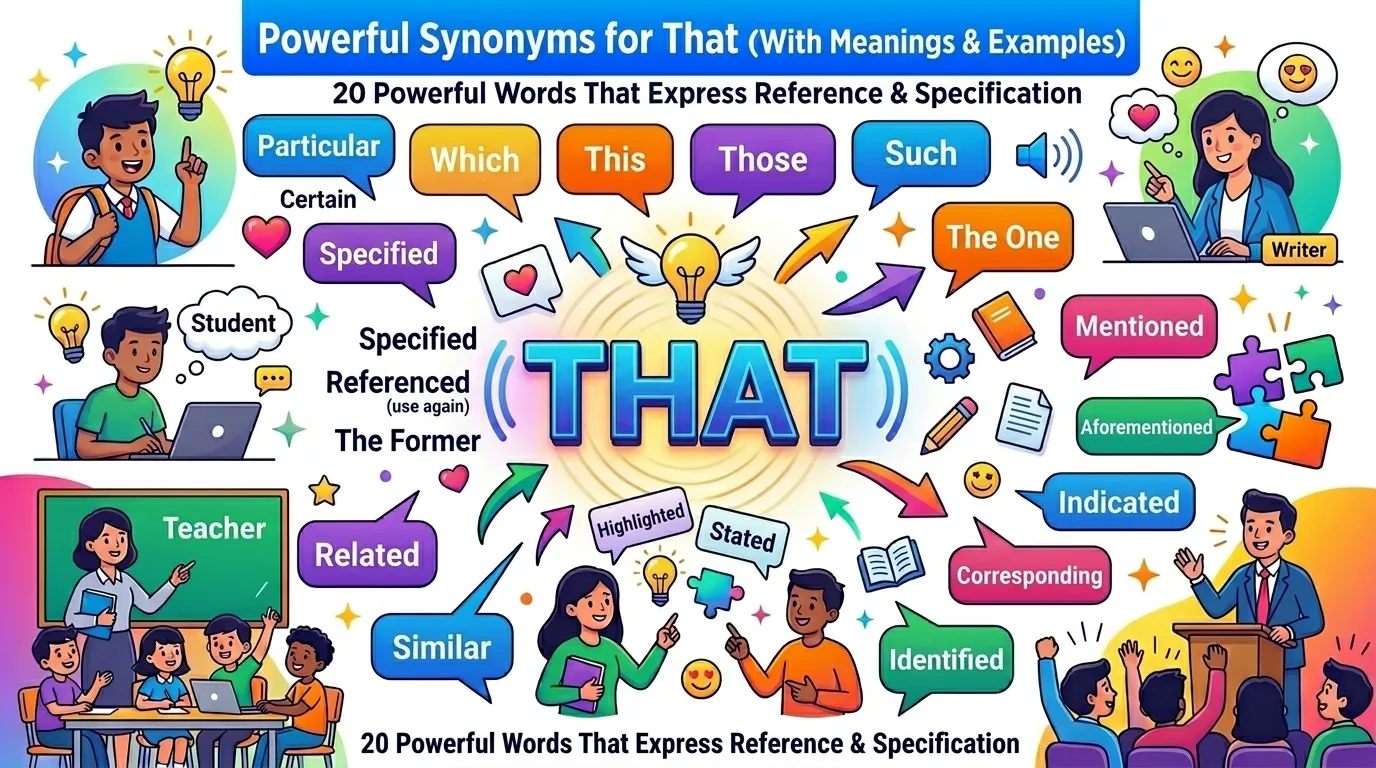
Top 5 Synonyms for That
- Which
- This
- Those
- Such
- The One
Synonyms for That (Categorized List)
1. Strong Synonyms
- Which
- Such
- Specified
- Particular
- Relevant
- Certain
- Designated
- Identified
- Corresponding
- Referenced
2. Formal Synonyms
- Aforementioned
- Said
- Mentioned
- Stated
- Declared
- Noted
- Cited
- Indicated
- Highlighted
- Previously Discussed
- Expressed
3. Informal Synonyms
- This
- Those
- The One
- Similar
- Related
- Named
- Pointed Out
- Quoted
- Specific
- Comparable
- Equivalent
- Mentioned Earlier
List of 33 Synonyms for That with Meanings and Examples
1. Which
Meaning
Used to identify a thing from a group.
Examples
- Which toy do you want?
- Tell me which book you bought.
2. This
Meaning
Used for something near you.
Examples
- This cake tastes great.
- I like this color.
3. Those
Meaning
Used for things that are far away.
Examples
- Those flowers look pretty.
- I remember those days.
4. Such
Meaning
Used to describe a type or kind.
Examples
- She is such a nice friend.
- It was such a fun game.
5. The One
Meaning
Refers to a specific person or thing.
Examples
- This is the one I wanted.
- He found the one from the list.
6. Said
Meaning
Refers to something already mentioned.
Examples
- The said plan worked well.
- We discussed the said topic.
7. Mentioned
Meaning
Already talked about before.
Examples
- The mentioned item is missing.
- I reviewed the mentioned file.
8. Aforementioned
Meaning
Previously referred to.
Examples
- The aforementioned rule applies here.
- Please read the aforementioned note.
9. Identified
Meaning
Clearly pointed out.
Examples
- The identified issue was fixed.
- We checked the identified area.
10. Specified
Meaning
Clearly stated.
Examples
- Follow the specified steps.
- Use the specified amount.
11. Referenced
Meaning
Mentioned as a source or point.
Examples
- The referenced article was helpful.
- I read the referenced guide.
12. Similar
Meaning
Almost the same.
Examples
- We have similar ideas.
- Their bags look similar.
13. Equivalent
Meaning
Equal in value or meaning.
Examples
- This answer is equivalent.
- Both amounts are equivalent.
14. Corresponding
Meaning
Matching another thing.
Examples
- Check the corresponding page.
- Find the corresponding number.
15. Related
Meaning
Connected in some way.
Examples
- We discussed related topics.
- She shared related information.
16. Comparable
Meaning
Able to be compared.
Examples
- The two phones are comparable.
- Their results are comparable.
17. Relevant
Meaning
Closely connected to the subject.
Examples
- Please give relevant details.
- The example is relevant.
18. Particular
Meaning
Specific and not general.
Examples
- I need that particular pen.
- She chose a particular seat.
19. Certain
Meaning
Specific but not named.
Examples
- A certain teacher helped me.
- I remember a certain day.
20. Specific
Meaning
Clearly defined.
Examples
- Give a specific reason.
- He asked a specific question.
21. Named
Meaning
Given a particular name.
Examples
- The named student won.
- We met the named person.
22. Designated
Meaning
Officially chosen.
Examples
- Use the designated area.
- Meet at the designated point.
23. Pointed Out
Meaning
Clearly indicated.
Examples
- She pointed out the mistake.
- He pointed out the answer.
24. Highlighted
Meaning
Given special attention.
Examples
- The highlighted section is important.
- Read the highlighted text.
25. Indicated
Meaning
Shown or suggested.
Examples
- The sign indicated danger.
- The map indicated the route.
26. Noted
Meaning
Recorded or observed.
Examples
- The noted changes helped.
- We reviewed the noted facts.
27. Cited
Meaning
Mentioned as evidence.
Examples
- The report cited research.
- She cited a useful source.
28. Quoted
Meaning
Repeated exact words.
Examples
- He quoted the teacher.
- The article quoted experts.
29. Expressed
Meaning
Communicated an idea.
Examples
- She expressed her opinion.
- He expressed thanks.
30. Stated
Meaning
Said clearly.
Examples
- The notice stated the rules.
- She stated her goal.
31. Declared
Meaning
Announced officially.
Examples
- They declared the winner.
- He declared his decision.
32. Mentioned Earlier
Meaning
Talked about before.
Examples
- The mentioned earlier topic returned.
- We reviewed the mentioned earlier point.
33. Previously Discussed
Meaning
Talked about in the past.
Examples
- The previously discussed plan succeeded.
- We followed the previously discussed idea.
When to Use Each Synonym of That
Use “Which”
When identifying something from a group.
Example: The book which I borrowed is excellent.
Use “Such”
When describing a type or quality.
Example: It was such a beautiful moment.
Use “Aforementioned”
In legal, academic, or formal writing.
Example: The aforementioned policy applies here.
Use “Relevant”
When discussing information related to a topic.
Example: Please provide relevant evidence.
Use “Particular”
When referring to one specific item.
Example: I need that particular document.
Synonyms for That in Different Contexts
In Business Writing
Common choices:
- Specified
- Designated
- Relevant
- Stated
- Referenced
Example: Follow the specified procedure.
In Daily Life
Common choices:
- This
- Those
- Similar
- Particular
- The One
Example: This is the one I wanted.
In Academic Writing
Common choices:
- Aforementioned
- Cited
- Referenced
- Corresponding
- Mentioned
Example: The cited research supports the argument.
Conclusion
Learning synonyms for that is a simple way to improve your English. It helps make your writing more interesting, your speaking more natural, and your communication clearer.
Whether you are a student, blogger, content writer, or everyday English learner, practicing that synonyms can strengthen your vocabulary. Try using words like which, such, specified, mentioned, relevant, and particular in your emails, essays, blog posts, and daily conversations.
Frequently Asked Questions (FAQs)
What are the best synonyms for that?
Some common synonyms for that include which, this, those, such, specified, mentioned, and particular. The best choice depends on the sentence and context.
Why should I learn synonyms for that?
Learning synonyms helps reduce repetition, improve writing quality, and make communication more engaging and professional.
Can I always replace that with a synonym?
No. The word that has different grammar functions. Some synonyms work only in specific situations.
Is that a pronoun or conjunction?
The word that can function as a pronoun, determiner, adverb, or conjunction depending on how it is used in a sentence.
How can students use that synonyms?
Students can use them in essays, assignments, presentations, and daily English practice to improve vocabulary and writing skills.

I’m Daniel Sterling, a passionate vocabulary writer and language enthusiast based in the United States. I specialize in writing simple, helpful, and easy-to-understand content about synonyms, word meanings, grammar, and everyday English communication.
I created this platform to help students, writers, bloggers, and English learners discover better words and improve their writing skills with confidence. I enjoy breaking down complex vocabulary into clear explanations with practical examples that anyone can understand.